Credit Card vs Debit Card in India (2026): The Mathematical Truth
You are standing at a checkout counter with two cards in your wallet.
You aren’t just choosing between two pieces of plastic. You are choosing between:
- Spending your own money immediately.
- Using the bank’s money strategically.
Conventional wisdom says: “Avoid credit cards. Cash is king.”
That advice is incomplete.
For a working professional, relying only on a debit card quietly costs you money. You miss out on keeping cash in your savings account longer, you get weaker fraud protection, and you end up with a “blank” credit history that makes future loans much more expensive.
At the same time, mismanaging a credit card can trap you in a nightmare of 36–48% annual interest.
This guide breaks down the actual math—not emotions—so you can pick the right tool for your wallet.
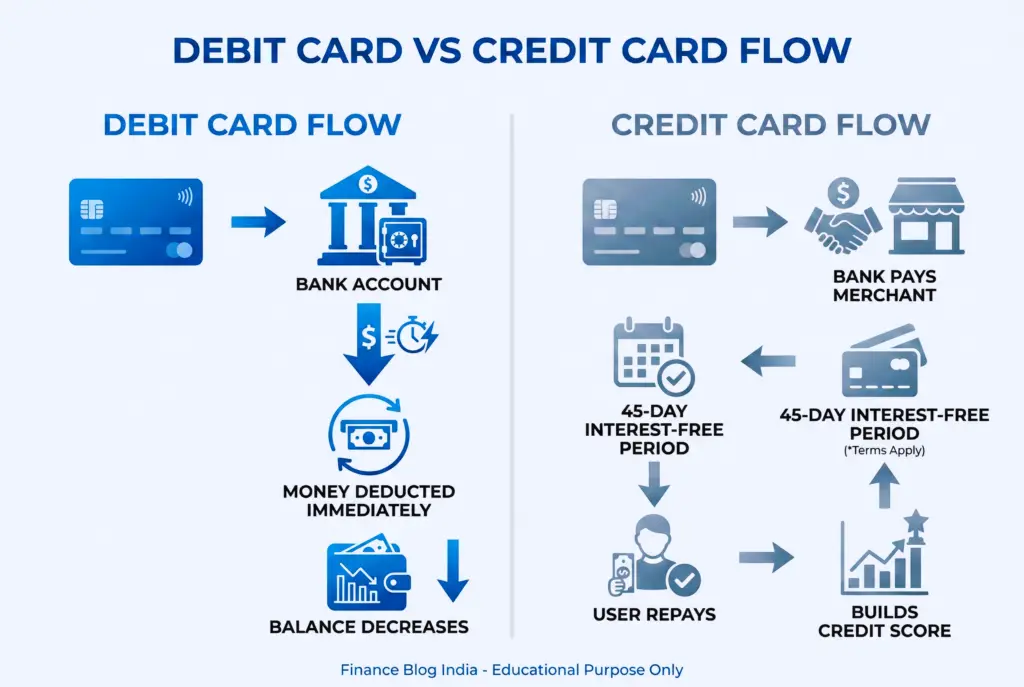
Credit Card vs Debit Card: The Core Difference
| Feature | Debit Card | Credit Card |
|---|---|---|
| Money Source | Your bank balance | Bank-approved credit limit |
| Interest | None | 36–48% p.a. if unpaid |
| Credit Score Impact | None | Builds CIBIL |
| Fraud Protection | Lower (money leaves instantly) | Higher (dispute before payment) |
| Liquidity | Immediate deduction | 30–45 day payment window |
“Key Insight: A debit card protects discipline. A credit card protects liquidity.”
- Debit Card: A tool to spend exactly what you have.
- Credit Card: A tool to borrow money for exactly one month
Neither is inherently good or bad. The outcome depends entirely on your habits.
1. The Debit Card: Simple, Safe, but Limited
A debit card directly deducts money from your savings account.
The Advantages:
- Zero debt risk: You can’t spend money you don’t have.
- Automatic control: It naturally stops you from overspending.
- Simple to manage: It’s very simple to use there is no headache.
Limitation: It does absolutely nothing to build your financial reputation. If you plan to take a home loan in 5 to 10 years, the bank will look at your credit history. If you’ve only used a debit card, they have no proof that you are a reliable borrower.
2. The Credit Card: Powerful, but Dangerous If Misused
A credit card is a short-term loan. You spend the bank’s money today and repay it later.
- If you pay the full amount before the due date, your interest is ₹0.
- If you don’t, the interest piles up at roughly 3–4% per month (plus 18% GST).
“That is exactly where most people lose control.”
The Math They Hide: The “Minimum Due” Trap
When your bill arrives, banks highlight the “Minimum Amount Due” (usually just 5% of your bill) to make paying it feel easy.
Let’s look at the real math. Imagine you buy a phone for ₹50,000, the interest rate is 3.5% per month, and you decide to pay only the 5% Minimum Due:
| Month | Starting Balance | Interest (incl. GST) | Payment | Principal Reduced | Remaining Balance |
| 1 | ₹50,000 | ₹2,065 | ₹2,500 | ₹435 | ₹49,565 |
| 2 | ₹49,565 | ₹2,047 | ₹2,478 | ₹431 | ₹49,134 |
| 6 | ₹47,800 | ₹1,974 | ₹2,390 | ₹416 | ₹47,384 |
The Reality Check: After 6 months, you have paid the bank ₹14,500, but your actual loan has only gone down by ₹2,600. At this pace, it will take many years to clear the balance, costing you more in interest than the phone itself.
The Golden Rule: If you cannot afford to buy it with cash today, do not put it on a credit card. The minimum due exists to protect the bank’s profits—not your wallet.
“Minimum due exists for the bank’s protection, not yours.“
The 30% Rule: The Hidden Credit Score Secret
Many people pay their bills on time but still have a weak credit score. The reason is usually their Credit Utilisation Ratio (how much of your total limit you are using).
If your credit card limit is ₹1,00,000 and you spend ₹80,000, you are using 80% of your limit. Banks view this as financial stress, and your score drops.
The Fix: Keep your usage below 30% of your total limit. (Pro tip: If you need to spend more, just pay off a chunk of the bill before the statement date to keep the reported number low).
How CIBIL calculates your score:
- 35% – Paying on time
- 30% – Keeping usage under 30%
- 15% – How long you’ve had the card
- 10% – Having different types of loans
- 10% – Applying for too many cards at once
(Note: Debit card usage contributes absolutely zero to this system).
The Optimisation Strategy:
Keep your utilization below 30% (e.g., spend under ₹30,000 if your limit is ₹1L).
- Pro Tip: If you need to spend more (e.g., ₹60,000), make a pre-payment to the card before the bill generates. This reports a lower balance to CIBIL.
The ₹5 Lakh Difference: Why Your Score Matters
Why do we care so much about this CIBIL score? Let’s compare a ₹50 lakh home loan (20-year tenure) for two different people:
| CIBIL Score | Interest Rate | EMI | Total Interest Paid |
| 750+ | 8.50% | ₹43,391 | ₹54.1 lakh |
| <700 | 9.25% | ₹45,793 | ₹59.9 lakh |
The Difference: The person with the lower score pays ₹2,402 extra every single month. Over 20 years, that is ₹5.8 lakh in additional interest! A strong CIBIL score is one of the smartest ways to ensure you can easily by securing a lower interest rate from day one.
A debit card builds no credit profile. A disciplined credit card user builds a financial asset.
Why Credit Cards Are Safer Online
| Debit Card Fraud | Credit Card Fraud |
| The money leaves your actual bank account immediately. You are left waiting weeks for a refund while your rent or grocery money is missing. | The transaction is disputed before you ever pay the bill. The bank bears the temporary risk, and your savings account remains completely untouched. |
When To Use Each Card
Use your Debit Card When:
- Withdrawing cash from an ATM (Never use a credit card for this).
- You know you struggle with impulse shopping.
- You already have existing debt to pay off.
Use your Credit Card When:
- Booking flights, hotels, or shopping online (for the fraud protection).
- Making planned, large purchases.
- Building your credit profile.
If you are disciplined, you get 30 to 45 “free” days to keep your own cash in a savings account earning 3-5% interest before you have to pay the credit card bill. It feels small per transaction, but it adds up over the years.
The Winning Strategy: Make the Bank Pay You
Banks secretly classify users into two categories:
- Revolvers: People who carry a balance and pay interest. (The Bank’s Profit).
- Transactors: People who pay in full and take the rewards. (The Bank’s Cost).
To win this game, be a Transactor:
- Always pay the Total Amount Due.
- Enable auto-debit so you never miss a date.
- Keep your card usage under 30%.
- Never use a card to finance a lifestyle you can’t afford.
If you follow this system, a credit card becomes:
- A fraud firewall
- A credit-building asset
- A reward engine
- A liquidity tool
If you break discipline, it becomes a 40% interest trap
Final Verdict
Debit cards protect your discipline. Credit cards build your financial future—if managed correctly. The piece of plastic is neutral; the math is not.
Quick Action Checklist
- Check your current credit utilization (ensure it’s under 30%).
- Enable auto-pay for the Full Amount (never the minimum due).
- Review your statement monthly for hidden charges.
- Never withdraw cash on a credit card.
Used correctly, credit builds leverage. Used emotionally, it builds debt.
“Be the bank’s cost, not its profit.“
Next Step
Ready to build your credit profile safely?
[Read: Best Lifetime Free Credit Cards for Beginners in India (2026)]